AIYEDATIWA FLAGS OFF DISTRIBUTION OF INDIGENOUS TREE SEEDLINGS TO FARMERS IN ONDO FOREST RESERVES
…As Government Moves to Enforce Agroforestry and Comply with EU Deforestation Regulation to Secure Cocoa Market Access
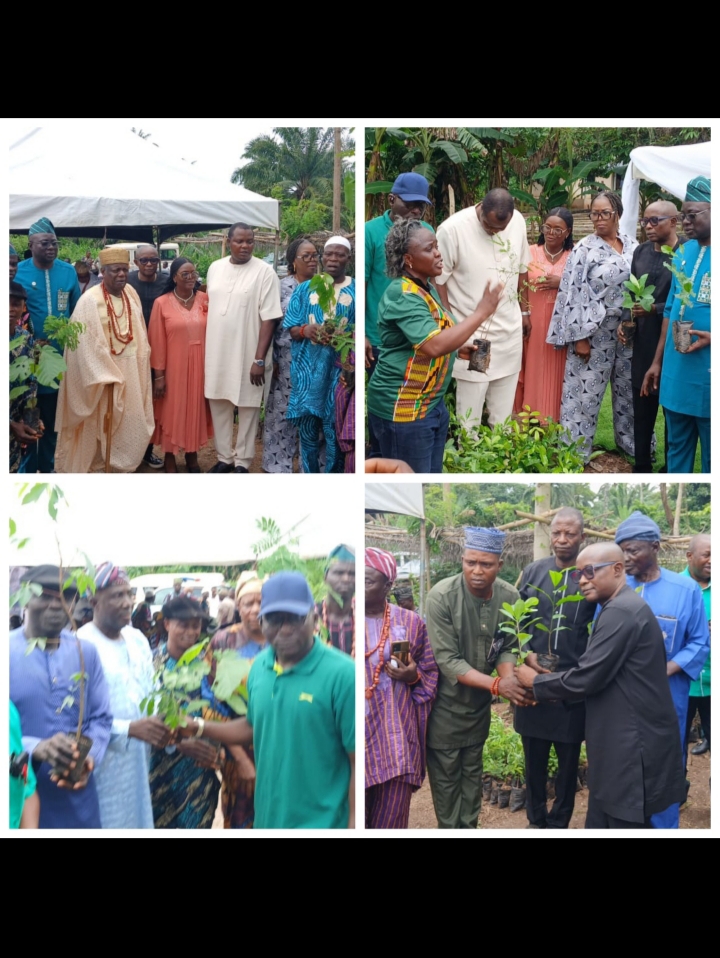
Ondo State Governor, His Excellency Dr. Lucky Orimisan Aiyedatiwa, has flagged off the distribution of indigenous tree seedlings to cocoa farmers in the Aponmu axis of the Akure Forest Reserve.
The Governor was represented at the event by the Commissioner for Agriculture and Forestry, Engr. Leye Akinola.
The initiative is in line with the Ondo State Government’s policy mandating farmers in forest reserves to practice agroforestry. It is also aimed at strengthening compliance with the European Union Deforestation Regulation, EUDR, to protect the forests and secure market access for the state’s cocoa.
Speaking at the flag-off, the Governor said the move was a bold step by his administration to reposition agriculture, protect the environment, and secure the future of the cocoa industry in Ondo State.
“As we are all aware, Ondo State is the leading producer of cocoa in Nigeria. The sector is dominated by smallholder farmers on an estimated 350,000 hectares of land, accounting for more than 34% of national output,” he said.
“A large portion of these farmers have their farms located within the state’s forest reserves. For decades, our farmers have been the backbone of our rural economy and a major contributor to Nigeria’s foreign exchange.”
The Governor, however, noted that cocoa production has also contributed to deforestation and degradation in the forest reserves.
“A significant portion of our forest reserve has been taken over by cocoa farmers. This poses a great risk to responsible cocoa production, biodiversity conservation, climate resilience, and global sustainability compliance.”
He explained that the European Union, a major market for Nigerian cocoa, enacted the EUDR which requires that commodities sold in the EU must not originate from land that was deforested or degraded after December 31, 2020.
“Compliance with the EUDR will enable our cocoa and other agricultural crops cultivated in the forest reserves before the end of 2020 to continue to have access to the European market. If we do not act, we risk losing access to a major market. If we act, we position produce from Ondo State as premium, sustainable, and climate smart.”
The Governor described the distribution of indigenous tree seedlings as “an investment in the future of our environment, our economy, and generations yet unborn.”
He added that indigenous trees are adapted to the local environment, support biodiversity, protect watersheds, improve soil fertility, and shield cocoa from excessive heat and wind. They also provide timber, fruits, medicinal plants, and other non-timber forest products.
He urged beneficiary farmers to treat the seedlings as valuable assets and to protect them from fire, illegal harvesting, and other destructive activities.
“The success of this programme depends not only on the distribution of the seedlings but also on their survival and growth. Your cooperation will determine if our cocoa remains competitive globally.”
The Governor commended the Ministry of Agriculture and Forestry, development partners, traditional rulers, and community leaders for their role in making the programme a reality.
He further called on youths, women, community associations, and private investors to actively participate in the state’s agroforestry initiative.
The Commissioner for Agriculture and Forestry, speaking through the Permanent Secretary, Forestry and Produce Sub-sector, Mr. Bosun Ogundipe, said:
1. *Mapping*: All eligible farmers must have their farms mapped in the ongoing polygon mapping exercise to ensure traceability of cocoa from each farm.
2. *Nurseries*: Nursery sites are being established in all forest reserves. Three have already been set up in Akure Forest Reserve, OA4, and OA3A.
3. *Seedling Allocation*: Farms in core protection zones will receive 300 seedlings per hectare, while those in sustainable use zones will get 40 seedlings per hectare.
4. *Species Distributed*: _Terminalia superba_ (Afara), _Mansonia_, Mahogany, _Ceiba_ (Araba), and _Parkia_ (Iru).
The Commissioner warned that any farm newly cultivated after the EUDR cut-off date would be at risk of destruction for violating forest laws and EUDR requirements.
He also directed the Ministry to ensure strict adherence to the 2020 cut-off date during verification and to promote agroforestry extension services across all cocoa-producing Local Government Areas.
The Chairman of the Timber Traders Organisation, TTO, and the Aladeokun of Alade-Idanre, Oba Ayodele Akinnadeju, urged traditional rulers to mobilize their subjects to plant the seedlings.
“Trees are very important to human existence,” he said, and appealed to farmers to cooperate with government to achieve the set goals.
In an interview, the Director of Conservation, Regeneration and Environmental Forestry, Mr. Tope Adebusoye, who is in charge of the programme, said the state government, through the department, has raised a total of *37,500 indigenous tree seedlings* so far. He added that the exercise is ongoing and more seedlings are being raised to ensure forest regeneration.
The Director noted that all farmers operating in the forest reserves whose farms were cultivated on or before the end of the year 2020 are expected to participate in the project across the state.
Also speaking, a consultant engaged by the government to collect fees as agreed by all stakeholders during various meetings held to ensure compliance with the European Union Deforestation Regulation, EUDR, Mr. Oluwafemi Michael Ajayi, also known as Alabura, said the distribution of seedlings would continue in other zones.
He stated that only farmers who have paid all necessary fees would be given seedlings.
Mr. Ajayi further said his team would ensure proper monitoring of the seedlings to confirm that they are planted and maintained. He stressed that the government would soon embark on aggressive enforcement to ensure total compliance with government policy and EUDR guidelines in order to protect the forests from extinction.