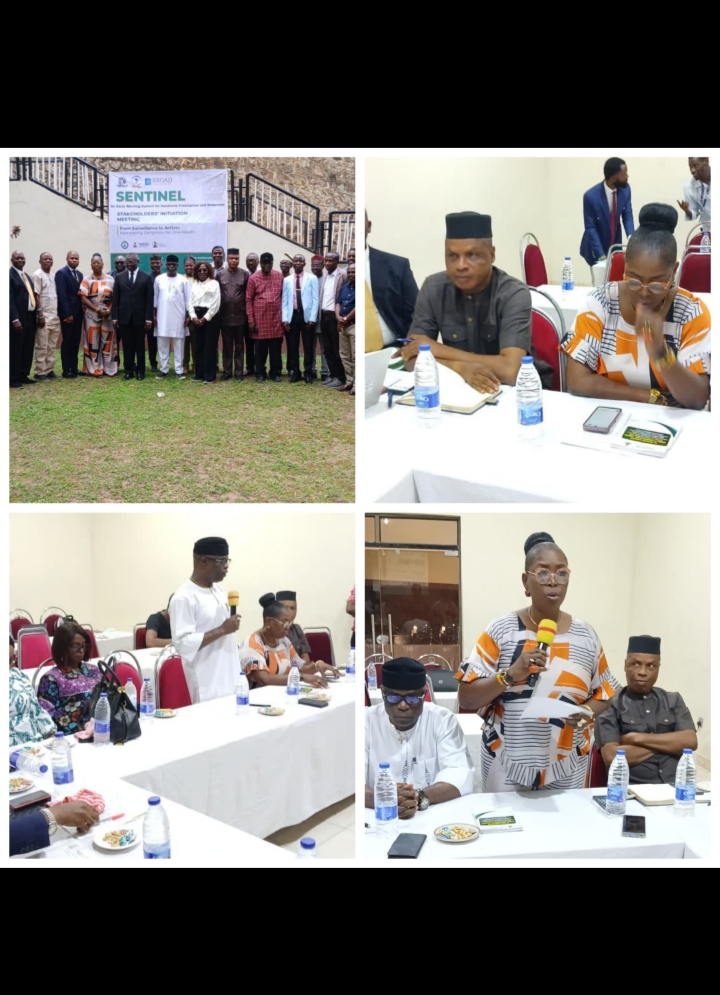
ODSG AFFIRMS COMMITMENT TO TACKLING DISEASES THROUGH ROBUST SURVEILLANCE AS SENTINEL PROJECT BEGINS IN ONDO
The Ondo State Government has reiterated its commitment to providing the necessary support and collaborating with relevant stakeholders in the fight against diseases in the state through robust research and surveillance networks.
The Commissioner for Agriculture and Forestry, Engr. Leye Akinola stated this at the launch of the SENTINEL. Project in Ondo State, which is the first location for the implementation of the SENTINEL 2.0 One Health Sub-Study.
The initiative is aimed at strengthening genomic surveillance and providing early warning for emerging and re-emerging zoonotic diseases in Nigeria.
The launch, held at the Royal Birds Hotel, Alagbaka, Akure, is titled: “Integrated One Health Genomic Surveillance for Early Detection and Characterization of Emerging and Re-emerging Zoonotic Pathogens for Public Health Response in Nigeria.”
Engr. Akinola, who was represented by the Permanent Secretary, Ministry of Agriculture and Forestry (Agricultural Sector), Mrs. Foluke Tunde-Daramola noted that the state is privileged to be the forerunner for the project which involves sampling in livestock farms, abattoirs, live animal markets, wildlife interfaces, bat roosts, rodent habitats, wet markets, free-range domestic and wild animals in households and communities across Ondo State.
According to him, this will help to detect germs early that could cause infections and spread rapidly to the entire community if not curbed on time.
The early detection will allow for rapid response and intervention with sustained monitoring to curb the menace of zoonotic and pandemic diseases among the people of the state.
The study will cover diseases such as HIV, Yellow Fever, Lassa Fever, Hepatitis A, B, C, COVID-19, Marburg, Mpox, Dengue, SARS, and other dangerous diseases whose dynamics of infection and spread affect humans and animals.
> “The impact of this study is expected in the areas of capacity building of staff, containment of outbreaks before spread, infrastructure development where necessary, data collection, processing and sharing of real-time data with government MDAs, and exposure to diagnostic and analytic technologies which are important for pandemic prevention and response,” he said.
The Commissioner added that in its effort to curtail the emergence of diseases, the Ministry of Agriculture and Forestry has constructed veterinary laboratories across the senatorial districts of the state.
Through the Livestock Productivity and Resilience Support (L-PRES) Project, th2 government has also constructed veterinary hospitals and clinics in Akure, Owo, Ikare, Ondo, Okitipupa, and Igbara-Oke to serve as centres for disease detection and intervention.
He added that the state has conducted vaccination campaigns targeting livestock and poultry diseases and has strengthened meat inspection and monitoring systems in abattoirs and slaughter facilities to enhance public health.
He stressed that the SENTINEL. One Health Sub-Study, which will run for the next five years, would bring tremendous improvement to the public health and general well-being of the people through:
Collaboration between the Institute of Genomics and Global Health (IGH) and ODSG Ministries of Agriculture, Health and Environment to improve intra-governmental relationships under the One Health Surveillance Initiative.
Capacity building for Ondo State personnel, local scientists and clinicians to drive their own community health responses.
The project, led by the Institute of Genomics and Global Health (IGH), Redeemer’s University, Ede, brought together representatives of the Ondo State Ministries of Agriculture and Forestry, Health, and Environment, as well as researchers and other stakeholders.
In his remarks, the Commissioner for Health, Dr. Banji Ajaka, represented by the Permanent Secretary, Dr. Ayodele Ojo Adiji described the project as a major benefit to the state because of its focus on disease prevention and early diagnosis.
He urged residents not to panic when professionals are collecting samples across the state, stressing that the activities would not harm them and their information would remain confidential in line with best practices.
Similarly, the Commissioner for Environment, Dr. Tob Loko, represented by his Special Assistant, Mr. Lanre Obaado said the ministry is ready to collaborate with researchers to ensure the environment is conducive and all components of the environment are protected.
In his address, the Director of the Institute of Genomics and Global Health and leader of the project, Professor Christian Happi said SENTINEL was designed to establish an early warning system capable of detecting pathogens before they develop into major epidemics.
Prof. Happi explained that the initiative differs from conventional disease surveillance because it brings the health, agriculture and environment sectors together to monitor disease threats across interconnected human, animal, and environmental ecosystems through an effective and efficient tracking system.
He added that Ondo State was selected because the government and its staff have shown commitment and readiness to work as a team for the success of the project. He noted that the approach would enable researchers and government authorities to identify pathogens circulating among animals or in the environment that could pose risks to humans, as well as detect zoonotic diseases moving between humans and animals before they spread.
“Information generated through the surveillance system will allow the government to make timely decisions and establish appropriate interventions to protect people, livestock, and the environment,” he said.
He therefore urged residents to cooperate with the project team, stressing that community participation would be essential to generating the data required for effective disease monitoring, prevention and control.
The Deputy Director for One Health Research and Zoonotic Disease Surveillance at IGH, Professor Anise Happi, said SENTINEL was an expansion of the institute’s previous disease surveillance work. She explained that the project adopted a One Health approach because infectious diseases can move between animals, humans, and the environment if necessary steps are not taken to curtail them.
According to her, the institute would provide infrastructure and technical support while working with the three relevant ministries to strengthen existing surveillance systems. She added that previous collaboration with Ondo State had demonstrated the willingness of government officials and communities to support disease surveillance activities, making the state a suitable starting point for the expanded project. The project will also support the training of state personnel, scientists and clinicians in genomics and bioinformatics, thereby improving local capacity and sustainability.
Speaking with journalists, the Ondo State Director of Veterinary Services, Dr. Oloruntoba Olodun described the project as a significant shift in the relationship between researchers and government. He said the initiative has attracted skilled professionals across relevant sectors to tackle diseases through rapid investigation and surveillance.
He said: “Researchers had previously collected samples, conducted studies and published findings without necessarily establishing direct mechanisms for government authorities to access and act on the information in real time. SENTINEL would create a closer working relationship between academia and government, allowing disease surveillance findings to inform policy and rapid intervention.”
Dr. Olodun stressed that early detection would enable the government to prepare for potential outbreaks and deploy personnel, equipment and other resources before diseases spread or become pandemics. He urged residents to cooperate with the project team, noting that researchers would work alongside personnel from the Ministries of Health, Agriculture and Environment.
He added that samples collected from hospitals, abattoirs, slaughter facilities and environmental sites would be analysed, with the resulting disease surveillance information made available to government authorities in real time.
The SENTINEL project is expected to strengthen Ondo State’s capacity for early disease detection, outbreak preparedness, genomic surveillance, data-driven decision-making and rapid public health intervention, while potentially providing a model for integrated One Health surveillance in other parts of Nigeria.