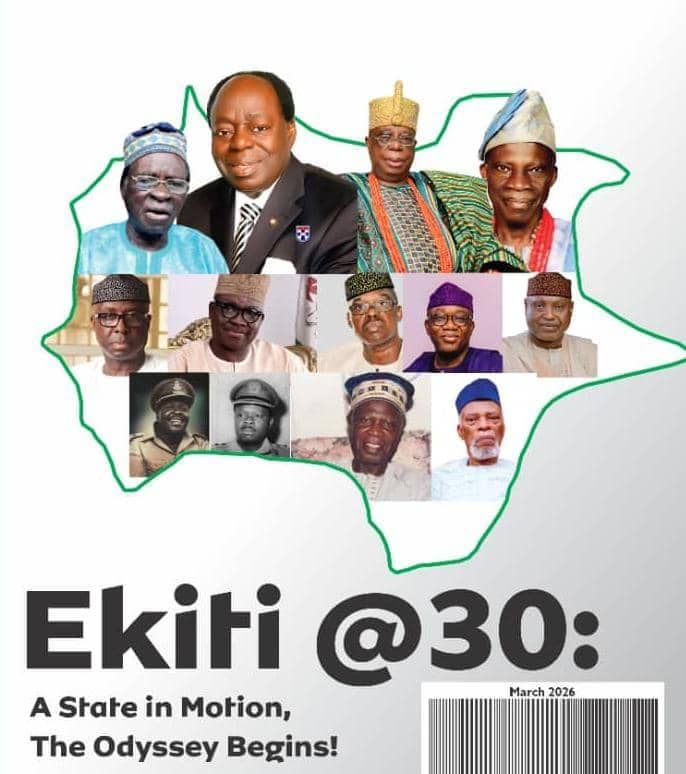
EKITI @ 30: A STATE IN MOTION, THE ODYSSEY BEGINS
“…From the Land of Honour to a Land of Opportunity, Innovation and Global Influence….”
By Femi Alufa
On October 1, 1996, Ekiti State was created out of the old Ondo State, fulfilling a long-standing aspiration of the people of Ekiti for a political space they could call their own within the Federal Republic of Nigeria. That aspiration was built on decades of sacrifice, mobilisation and collective determination.
Thirty years later, Ekiti has every reason to celebrate how far it has come. But an anniversary should be more than a celebration of the past; it should also be an invitation to imagine the future.
The fundamental question before us is therefore: What kind of Ekiti do we want to build over the next 30 years?
If the first 30 years were about establishing Ekiti as a state, the next 30 must be about establishing Ekiti as a model society—prosperous, peaceful, educated, technologically advanced, culturally confident and globally connected.
My dream is simple: an Ekiti that is better than the one we inherited and worthy of the generation that will inherit it from us.
*Education: Our Greatest Natural Resource*
Education must remain at the centre of Ekiti’s development. Our greatest competitive advantage is not oil, gold or natural gas, but the intellectual capacity of our people.
By 2056, every Ekiti child—from Efon-Alaaye to Ikere, Ise-Orun to Ikole—should have access to quality education regardless of family income or geographical location.
We must move beyond merely building schools to building a knowledge economy. Our curriculum should prepare young people for artificial intelligence, robotics, renewable energy, biotechnology, cybersecurity, digital governance, advanced agriculture, creative industries and entrepreneurship.
Ekiti should deliberately position itself as Nigeria’s Education and Knowledge Capital, with universities, polytechnics, colleges and research institutions serving as engines of innovation, creativity and enterprise.
Every local government should also have modern vocational and technical centres where young people can acquire practical skills for employment and enterprise.
But education without opportunity can produce frustration. Our graduates must be able to build their futures at home.
*Building an Economy of Opportunity*
The Ekiti of 2056 should be an economy where talent does not have to migrate before it can prosper.
We must create an ecosystem that supports small and medium-scale enterprises, technology start-ups, professional services, creative industries and agro-industrial enterprises.
An Ekiti graduate should be able to establish a technology company in Ado-Ekiti, operate a global consultancy from Ikere, run an agro-processing business in Ikole, develop a creative enterprise in Ijero or export digital services from Efon-Alaaye to the world.
Our young people should increasingly become creators of wealth, not permanent seekers of government employment.
*Agriculture: From Farming to Agro-Industry*
Agriculture must become one of the pillars of Ekiti’s economic transformation.
With fertile land, hardworking farmers and a strong agricultural tradition, Ekiti has the foundation for a major agro-industrial economy. The challenge is to move from subsistence farming to profitable, technology-driven agriculture.
Strategic crops such as cassava, rice, cocoa, cashew, maize, yam and vegetables should receive sustained attention, alongside livestock and poultry.
We need modern extension services, irrigation, mechanisation, improved seedlings, access to finance, storage, rural roads, processing facilities and organised markets.
The goal should not simply be to produce and export raw materials. Cassava should become starch and industrial products; cocoa should be processed locally; fruits should become packaged products; and agricultural clusters should create jobs and wealth within Ekiti.
By 2056, Ekiti should be recognised not merely as a farming state, but as a major agro-industrial hub.
*Infrastructure, Technology and Energy*
No modern economy can prosper without infrastructure.
The next 30 years should witness an infrastructure revolution covering roads, electricity, water, housing, transportation and broadband connectivity.
Digital connectivity must be treated as essential infrastructure. A young person in a rural Ekiti community should have access to the same global knowledge and digital opportunities available in Lagos, London or New York.
With its renewable-energy potential, Ekiti can expand solar power, mini-grids and other clean-energy solutions, particularly for underserved communities.
Through strong public-private partnerships, Ekiti can develop its own CyberHills—a technology and innovation ecosystem built around our intellectual capital.
*Healthcare and Human Dignity*
A prosperous society must also be a healthy society.
Ekiti should invest in modern primary and specialist healthcare, maternal and child health, preventive medicine, medical laboratories, emergency response and telemedicine.
Partnerships with universities, private healthcare providers, development agencies and the diaspora can help attract expertise and investment.
Our children, vulnerable citizens and elderly people must remain central to the development agenda. The dignity of every citizen should be a measure of our progress.
*Culture, Heritage and Tourism*
Ekiti’s history and culture are among its greatest untapped resources.
Our traditional institutions, festivals, oral traditions, historic personalities, sacred sites, architecture, music, arts and indigenous knowledge constitute both a cultural inheritance and an economic resource.
The next 30 years should produce a comprehensive Ekiti Heritage Economy, with digital archives, museums, cultural centres, heritage routes and professionally developed historical sites.
Tourist attractions such as Ikogosi Warm Springs should be developed to international standards, while other historical and cultural sites across the state should be documented, preserved and promoted.
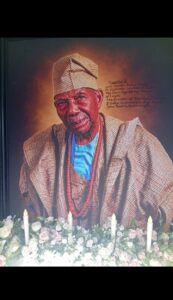
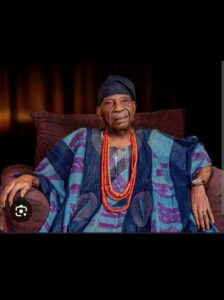
The stories of Ekiti’s heroes, heroines and icons—including Fabunmi of Okemesi, Mummy Helena Doherty, Colonel Adekunle Fajuyi, High Chief (Dr.) J. E. Babatola, Chief Akin Omoboriowo, Lady Deborah Jibowu, Aare Afe Babalola, Chief Deji Fasuan, Professor Niyi Osundare and our traditional rulers, including His Imperial Majesty Oba Dr. Rufus Adeyemo Adejugbe, the Ewi of Ado-Ekiti, and other living icons—should be preserved in books, films, museums and digital platforms.
A people without historical memory can easily lose their sense of identity.
We must therefore preserve our heritage while creating legitimate economic value from it.
*Good Governance and the Ekiti Diaspora*
Good governance remains a catalyst for sustainable development.
The Ekiti of the future must embrace transparency, accountability, evidence-based policymaking, citizen participation and digital government. Public budgets should translate into visible projects, measurable services and better lives.
Our traditional rulers, communities and local institutions should also become partners in development.
Equally important is the Ekiti diaspora. Our professionals, academics, entrepreneurs and business leaders across Nigeria and around the world represent an enormous reservoir of knowledge, capital and networks.
An Ekiti Diaspora Development Network, supported by investment incentives, knowledge-transfer programmes and professional partnerships, could transform this human capital into a powerful development resource.
*A Covenant Across Generations*
The next 30 years cannot belong to government alone. They must belong to all of us—traditional rulers, academics, professionals, entrepreneurs, farmers, women, young people, civil society, religious institutions, persons with disabilities and the Ekiti diaspora.
The generation of EkitiParapo that fought for freedom and dignity in the nineteenth century left us a legacy of courage. The generation that fought for the creation of Ekiti State secured our political space within Nigeria.
Our generation must leave the next generation a prosperous society.
That is the real challenge of Ekiti at 30.
By 2056, when Ekiti celebrates 60 years of statehood, I want our children to look back and say that between 2026 and 2056, Ekiti discovered its confidence, invested in its people, transformed agriculture, embraced technology, preserved its heritage, strengthened its institutions and connected itself to the world.
That is the Ekiti I dream of.
An Ekiti where our past inspires our future, our people create opportunity, and every generation inherits a better land than the one it received.
From the Land of Honour to a Land of Opportunity, Innovation and Global Influence.
That is the Ekiti we must build.
*THE AWAKENING*
And so, as Ekiti stands at the threshold of another thirty years, our aspiration must rise beyond the celebration of statehood to the construction of a society worthy of its history and its children.
May we build an Ekiti where knowledge is free, where reason is fearless, where opportunity is not the privilege of a few, where our heritage illuminates our future, and where every child can dream without the limitations of poverty, geography or circumstance.
In the timeless words of Nobel Laureate Rabindranath Tagore, from Gitanjali:
“Where the mind is without fear and the head is held high;
Where knowledge is free;
…
Into that heaven of freedom, my Father,
Let my country awake.”
May Ekiti awake.
May her children arise.
May her institutions grow stronger.
May her heritage endure.
May her people prosper.
And may the next thirty years become the beginning of an even greater Ekiti odyssey.
Happy 30th Anniversary to Ekiti State!
Congratulations to all Ekitikete!
— Femi Alufa is the
Publisher and Chief Executive Officer of
Ekiti Summit News Media Group