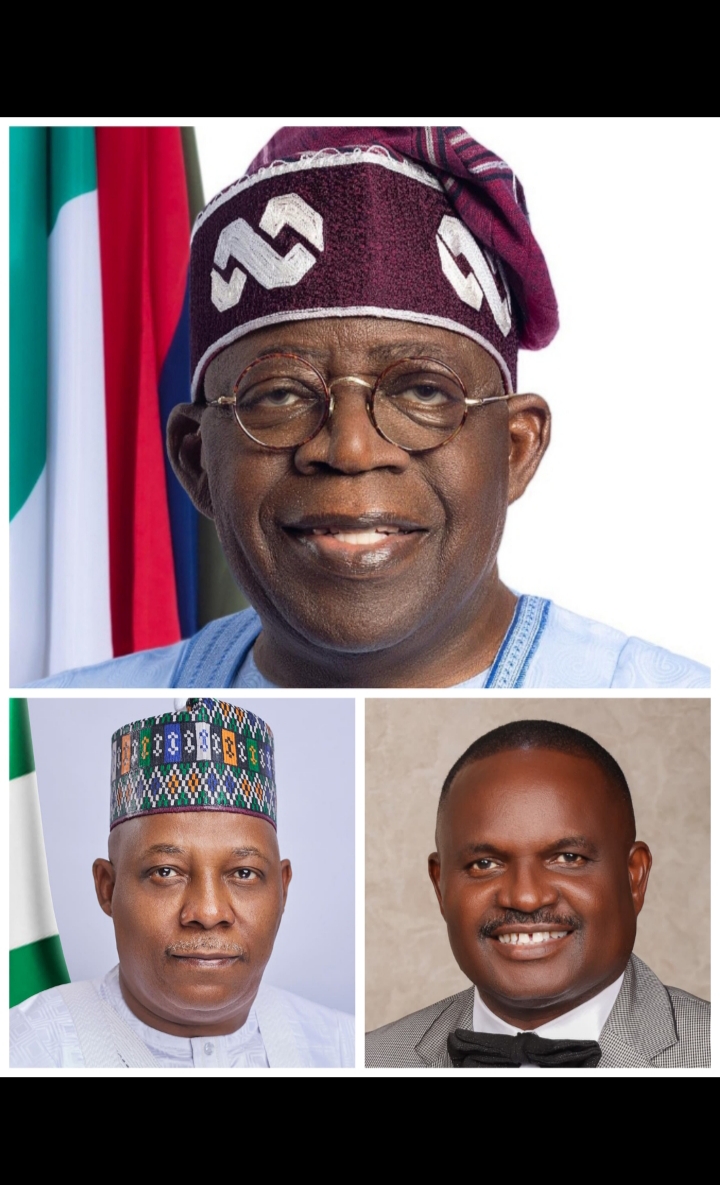
TINUBU AND SHETTIMA: A PARTNERSHIP OF VISION, REPRESENTATION AND GLOBAL LEADERSHIP
By Felix Babatunde Ale, PhD
In the chronicles of Nigeria’s political history, few partnerships have embodied unity, loyalty, and intellectual depth as profoundly as that of President Bola Ahmed Tinubu and Vice President Kashim Shettima.
Their relationship is not merely political; it is a fusion of vision and representation, a synergy that has begun to redefine Nigeria’s image both at home and abroad. Aristotle once observed, “The whole is greater than the sum of its parts.”
The Tinubu-Shettima partnership exemplifies this truth. Together, they represent a leadership that is both strategic and symbolic, with Tinubu’s endowed intellect, and seasoned statesmanship complemented by Shettima’s diplomatic finesse.
The cordiality between the President and his Vice President is evident in the trust Tinubu places in Shettima to represent him at critical national and international fora.
This trust is not misplaced. Shettima has consistently demonstrated loyalty, competence, and brilliance, embodying the spirit of partnership that Nigeria desperately needs in this era of global interconnectedness.
Leadership scholar John Maxwell once said: “A leader is one who knows the way, goes the way, and shows the way.” Tinubu knows the way, and Shettima has shown the way by representing Nigeria with dignity and intellectual vigor.
The most commendable example of Shettima’s representation came at the 18th BRICS Leaders Summit in New Delhi, India.
Standing among eminent leaders such as President Xi Jinping of China, President Vladimir Putin of Russia, Prime Minister Narendra Modi of India, and President Cyril Ramaphosa of South Africa, Shettima carried Nigeria’s banner with pride. His presentation was not only brilliant but also deeply inspiring, earning Nigeria respect and admiration on the global stage.
The summit was symbolic, attended by dignitaries from across the globe, and Nigeria’s presence was amplified by Shettima’s intellectual display. His speech resonated with themes of resilience, innovation, and Africa’s emerging role in global governance.
As one who once served as an honorary council member of the School of Communication in a leading Indian university, I received numerous calls from scholars, journalists, students, and members of the space science community praising Shettima’s performance.
One television journalist confessed: “I could not stop listening repeatedly to Vice President Shettima’s speech. Each replay gave me a new angle for positive reporting, because of the tenacity of his delivery and his brilliant power of oratory.” This feedback was not only impressive but also made me proud as a Nigerian.
It underscored the fact that Nigeria’s leaders are capable of standing shoulder to shoulder with the world’s finest.
Representation is more than presence; it is about projecting values, vision, and identity. Shettima’s representation at BRICS was symbolic of Nigeria’s readiness to engage in global discourse.
His eloquence reminded the world that Africa is not a passive participant but an active contributor to global knowledge and policy. Ralph Waldo Emerson once said: “The world belongs to the energetic.” Shettima’s energy, intellect, and eloquence ensured that Nigeria’s voice was heard, respected, and admired.
Beyond diplomacy, the TinubuShettima partnership has profound implications for Nigeria’s space programme. At the level of the Nigeria Space Council, which is the highest decisionmaking body for the National Space Research and Development Agency (NASRDA), President Tinubu serves as Chairman while Vice President Shettima serves as Vice Chairman.
The pragmatic and resourceful Director-General of NASRDA, Professor Matthew Adepoju is Secretary of the Space Council. Space enterprise anywhere in the world is never handled by mediocres but by great minds.
Shettima’s intellectual display in a spacedominated environment is a plus and a value addition to Nigeria’s space policy and programmes. His role reinforces Nigeria’s reputation as Africa’s leading space nation and one of the fastestgrowing in the world.
As someone who has enjoyed extensive interactions with foreign journalists in the course of my assignments as spokesperson for NASRDA, Africa’s leading space Agency. I can testify that the feedback from India about Shettima’s performance was highly commendable.
In my role as a leading science writer and communicator in Africa, I have often seen how narratives shape perception. The story of Shettima’s outing at BRICS is one such narrative that uplifts Nigeria’s image. It is a reminder that our leaders are capable of intellectual brilliance and diplomatic finesse that resonate globally.
Nelson Mandela once said, “Education is the most powerful weapon which you can use to change the world.” Ralph Nader reminded us that “The function of leadership is to produce more leaders, not more followers.” Eleanor Roosevelt added: “Great minds discuss ideas; average minds discuss events; small minds discuss people.”
These quotations reflect the essence of the Tinubu-Shettima leadership: visionary, ideadriven, and committed to producing more leaders for Nigeria’s future.
The lesson for Nigerians is clear: support this partnership.
Tinubu and Shettima represent a rare combination of vision and representation. Their leadership is not only about governance but about projecting Nigeria’s image globally, advancing socioeconomic development, and inspiring the next generation. Young Nigerians must understand that the current moment is critical.
As the Bible reminds us in Ecclesiastes 9:10: “Whatever your hand finds to do, do it with all your might.” The pursuit of education, innovation, and excellence today will lay the foundation for tomorrow’s greatness.
Nigeria is indeed lucky to have Asiwaju Bola Ahmed Tinubu and Alhaji Kashim Shettima as President and Vice President. Their partnership is a beacon of hope, a symbol of unity, and a testament to Nigeria’s potential. As Shettima’s brilliant representation at BRICS demonstrated, Nigeria can stand tall among nations.
At the Nigeria Space Council, their leadership is shaping Africa’s cosmic future. Let us, therefore, support them in the actualization of their dreams for a greater Nigeria, a proud and virile nation of our collective aspiration.
Dr. Felix Babatunde Ale is a multiple merit awards winning journalist, Leading Science Writers and Communicators in Africa and Director, Media and Corporate Communication of NASRDA.