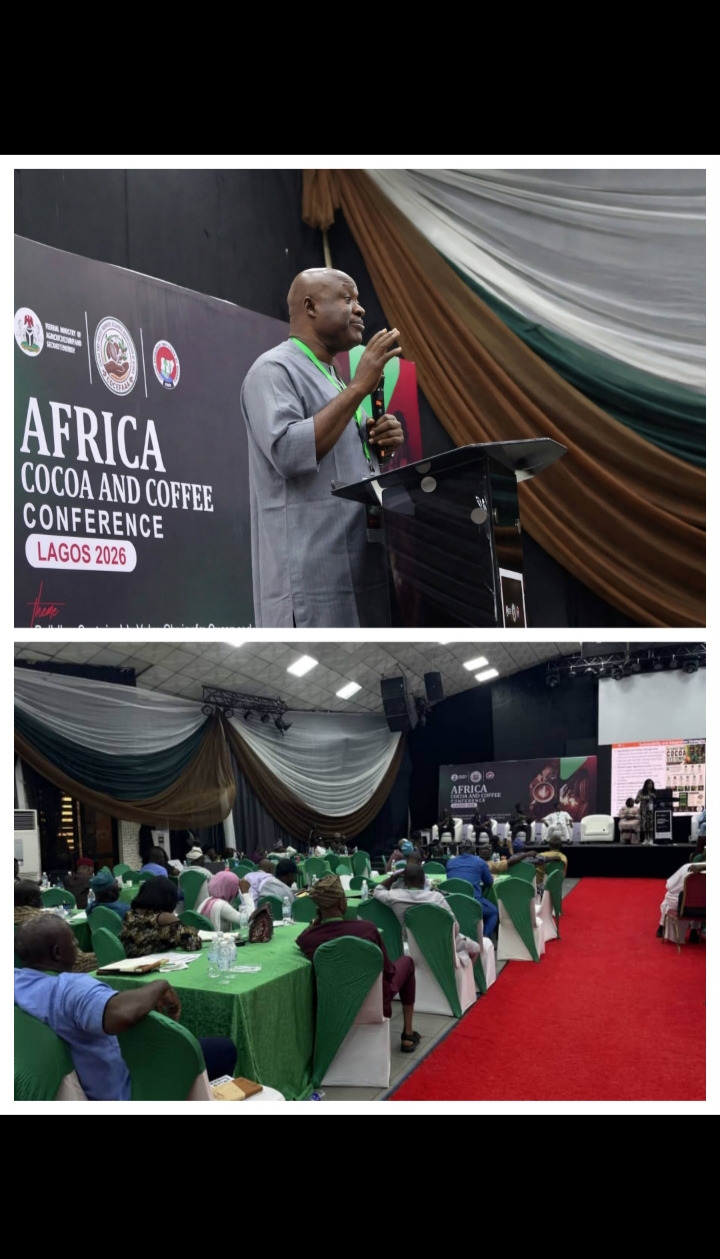
COCOA AND COFFEE FARMERS ALLIANCE ASSOCIATION OF AFRICA MAKES DECLARATION TO PROTECT MEMBERS’, CONTINENT’S INTEREST
… Declaration Announced By Global President Adeola Adegoke Is Aimed At Strengthening Global Negotiations
The Cocoa and Coffee Farmers Alliance Association of Africa has emphasized the need for stakeholders, especially the farmers to benefit from government policies.
The Association also stressed that the farmers should not only be the growers but also have profitable returns on their investments.
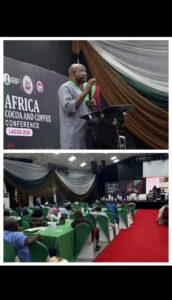
This was part of the declaration announced at the Africa Cocoa and Coffee Conference held in Lagos.
According to the declaration made public by the Global President of the Association, Comrade Adeola Adegoke, the Lagos Pact on Commodity Integrity will serve as Africa’s common position at the African Union Summit in February 2027.
(Full Details of the Declaration)
LAGOS CONFERENCE CLOSES WITH THE LAGOS DECLARATION
The two-day Africa Cocoa and Coffee Conference in Lagos closed with the formal adoption of
two landmark documents: the Lagos Declaration 2026, a shared statement of commitments
for African cocoa and coffee value chains, and the Lagos Pact on Commodity Integrity, which
will serve as Africa’s Common Position at the African Union Summit in February 2027.
The
Global President of the Cocoa and Coffee Farmers Alliance Association of Africa (COCEFAAA)
– Comrade Adeola Adegoke announced the Pact alongside a new continental body, the Lagos
Continental Co-Design Council.
More than 200 delegates were recorded across the two days, drawn from cocoa and coffee
origin-producing countries, governments, research institutions, development partners,
commodity associations, the private sector, multilateral organisations and the media.
Among those present were: The Hon. Minister of Agriculture and Food Security, Nigeria –
Senator Abubakar Kyari, represented by Mr. Ajayi Olutobaba, Deputy Director of Tree
Crops; The Cocoa Research Institute of Nigeria (CRIN) fielded a delegation led by Ag. Executive
Director Dr. A.R. Adedeji; Sunbeth Global Concepts Managing Director- Mr Olasunkanmi
Owoyemi represented by Abdulsamad Abdulrahman , the Deputy Governor of Abia State,
His Excellency, Engr. Ikechukwu Emetu; Lagos State Government represented by
Honourable Commissioner of Agriculture and Food Systems – Ms. Ruth Abisola Olusanya;
Ondo State Government represented by the Permanent Secretary of Ondo State Ministry of
Agriculture and Forestry – Mrs. Foluke-Tunde Daramola; Cross River State Government
represented by the Permanent Secretary of Cross River State Ministry of Agriculture and
Irrigation Development – Mr. Ikongha Odey Joseph and Chairperson, Cross River
Multi-stakeholder Committee for Cocoa, Coffee and Oil Palm – Prof. Susana Ohen; the
Executive Director of the Nigerian Export Promotion Council (NEPC) – Mrs Nonye Ayeni
represented by Mr. Benedict Itegbe; Senator Gbolahan Dada and Mr Ayo Akinola
representing National Cocoa Management Committee (NCMC); Prof. David Olusoji Adejumo
representing Olubadan of Ibadanland; DAWN Commission; and delegations from Ondo, Ogun,
Osun, Kwara, Edo, Cross River, Lagos and Abia States.
Moreover, from the cocoa and coffee producing origin countries – Sierra Leone Produce
Monitoring Board delegation was led by Executive Chairman Raymond Katta, with
Didan Sankoh, Director of Operations and Programmes. Côte d’Ivoire–Ghana Cocoa
Initiative (CIGCI) through Adaku Widad Quaye, and by the Embassy of Côte d’Ivoire in
Nigeria, led by Dr. Mustapha Kouassi. PBC Limited -Seidu Yonye and Nestor Naabule
Nasage, , PhD from Ghana; Prince Mahamadou Mamouda Almed, President of
MECOBA; Jack Ndirangu, the Chairman of Kahiraini Coffee Factory, Kenya and Abel
Ayele Bunaro – Chairman and CEO, Bunaroma Coffee Export Ethiopia.
Also, from the
consumption countries like UK, USA, and EU states.
Furthermore, development partners and research bodies include The International
Labour Organization (ILO), represented by National Project Manager, Mrs Celine Oni;
the International Institute of Tropical Agriculture (IITA) – Mrs Ranjana Bhattacharjee;
the World Cocoa Foundation, represented by Dr. Mawuli Coffie and Uzoamaka
Ugochukwu; the FAO-GEF project, including Prof. Adebayo Shittu and Prof. Oladapo
Akinyemi; Cross River State Cocoa MSP; Rainforest Alliance represented by Mr Kazeem
Sanni – the Manager, Producer Support – Nigeria, the Natural Resources Institute;
Springboard Managing Director – Mr Lawrence Afere represented by Mercy Umoru;
and Lutheran World Relief/TRACE represented by Mr Nene Akwetey-Kodjoe and Mr.
Olawale Awoyemi.
Also, Commodity associations and NGOs like The Cocoa Processors Association of
Nigeria, led by National President- Otunba Felix Oladunjoye who is also the Chief
Executive Officer of A.Y & Rolly’s Ventures Limited; the Cocoa Farmers Association of
Nigeria (CFAN); National Coffee and Tea Association of Nigeria (NACOFTAN), led by Dr.
Hassan Usman Kakara; International Cocoa Diplomacy, represented by its founder,
HRM Oba Dokun Thompson; and Oil Palm Growers’ Association of Nigeria – Mr Joe
Onyiuke Esq.
Further, private sector and partners include: Olam Food Ingredients (OFI) represented
by Mr Kayode Abolarin and Mrs Agatha Ewolor, Johnvent Group led by Saloni Goyal,
Lingzhi led by the Managing Director – Mrs Blessing Nanman Tangtur , Agnimble led
the Chief Executive Officer – Mr Nsidibe Etim, and also a member of COCEFAAA Board
of Directors, Validproof Managing Director – Olayemi Joshua Akinsanya, Alpha Agro
Allied Ltd – Mr. Nnamdi Onyechi, FoodMasters represented by the Project Sales – Dr.
Henrik Sontheimer, Sterling Bank represented by Ada Ufomadu, COCEFAAA country
chapters: Cote d’Ivoire Chapter led by Nabyoullah Dosso, represented by Badjeneba
Bamba and Dr. Liliane Kabondo – also COCEFAAA Board Member; Ghana Chapter led
by the Country Director – Nana Yaw Reuben and James Kwarteng Cameroon Chapter
by Epie Promise Ngol’epie, and Paviet Molonga COCEFAAA state chapters from the
cocoa and coffee producing states in Nigeria.
The Declaration commits participants to act as a united African bloc, strengthen the
coordinating role of the Cocoa and Coffee Farmers Alliance Association of Africa
(COCEFAAA), and turn the Lagos conference into a mechanism for sustained action with
measurable outcomes.
Delivering the closing statement before ministers, heads of delegations, and leaders of
international and continental institutions, the Global President said the conference had
shown that “Africa is not short of solutions. We are short of mechanisms to scale them.”
The Challenge
Africa produces 75% of the world’s cocoa and 12% of its coffee, yet captures less than
6% of chocolate value, and farmers earn about $1.20 a day, the Global President told
delegates. He identified two emerging threats:
• EUDR regulations, which could exclude 40% of African smallholders from the
European market.
• Cell-cultured cocoa, backed by $350 million in investment, which aims to replace
17% of the market. The statement put the potential loss to African communities at
$3.1 billion.
The Lagos Declaration 2026
The Declaration, written for collective recitation, commits participants to build
prosperous farmers and greater African ownership of cocoa and coffee value chains.
It sets out commitments across eight areas:
Area
Commitment
Planning and
coordination
• Develop African strategic plans with clear mandates, action
programmes, timelines, expected outcomes and measurable
indicators.
• Establish a Technical Working Group with defined
responsibilities to coordinate implementation, monitor
results and report progress.
Unity and
governance
• Act as a united African bloc and strengthen COCEFAAA’s
coordinating role.
• Modernise laws, protect farmers’ rights and build
accountable institutions.
Farmers first
• Uphold farmers’ dignity, improve incomes and strengthen
cooperatives.
Productivity
• Increase productivity, renew farms, and invest in research,
innovation and extension.
Sustainability
• Protect forests, strengthen climate resilience and produce
responsibly.
Traceability
and identity
• Build trusted traceability, support fair compliance and
protect farmers’ data right.
Area
Commitment
• Protect product identity, promote transparent labelling and
ensure innovation benefits farmers.
Value and
finance
• Capture greater value in Africa by expanding processing,
strengthening national brands and harnessing AfCFTA
markets.
• Mobilise an innovation and resilience fund to support
enterprises from product development to market and
expand opportunities for women and young people.
People and
welfare
• Protect children and workers, promote decent work and
improve farmer healthcare.
The Declaration also records the need for a tree crop guideline or policy, describing it as
collaborative action that must be pushed for at all levels.
Participants committed to
making Lagos a mechanism for sustained action: to mobilise resources, scale successful
African solutions and deliver measurable outcomes.
It closes with a shared pledge:
“Together, we commit to African solutions, prosperous farmers and greater African
ownership of cocoa and coffee value chains.”
The Lagos Pact: Three Non-Negotiables
The Pact sets out three positions that African origins will carry into continental and
global negotiations:
1. The terms “Cocoa” and “Coffee” must be reserved for farmed products only.
2. Mandatory “Cell-Cultured Product” labelling at Codex.
3. A 1% Adaptation Levy on cell-cultured revenues, to benefit African smallholders
through the Common Fund for Commodities (CFC).
COCEFAAA Repositioned
COCEFAAA is no longer a technical forum: it is now Africa’s Strategic Interlocutory
Mechanism, the Global President announced.
It is mandated to negotiate on behalf of all
African origins with the African Union, AfCFTA, IACO, ICCO, CFC, the European
Commission and Codex. “We will engage as One Africa,” he said.
The Graduation Agenda
Drawing on proof-of-concepts shared at the conference, COCEFAAA will:
• Develop a COCEFAAA Model Law based on Sierra Leone’s reforms.
• Advance a Continental LID (Living Income Differential) under AfCFTA.
• Establish a Pan-African Geographical Indication (GI) Registry with IACO.
The conference heard that Sierra Leone replaced a 40-year-old colonial law with a new
Produce Monitoring Board Act, delivered three factories in 18 months under its Made-in Sierra Leone Policy, and introduced Africa’s first Agricultural Health Insurance Scheme
for farmers.
Ghana and Côte d’Ivoire showed how the LID makes Africa a price-maker.
Ethiopia and Rwanda presented GI tagging and branding that captures value.