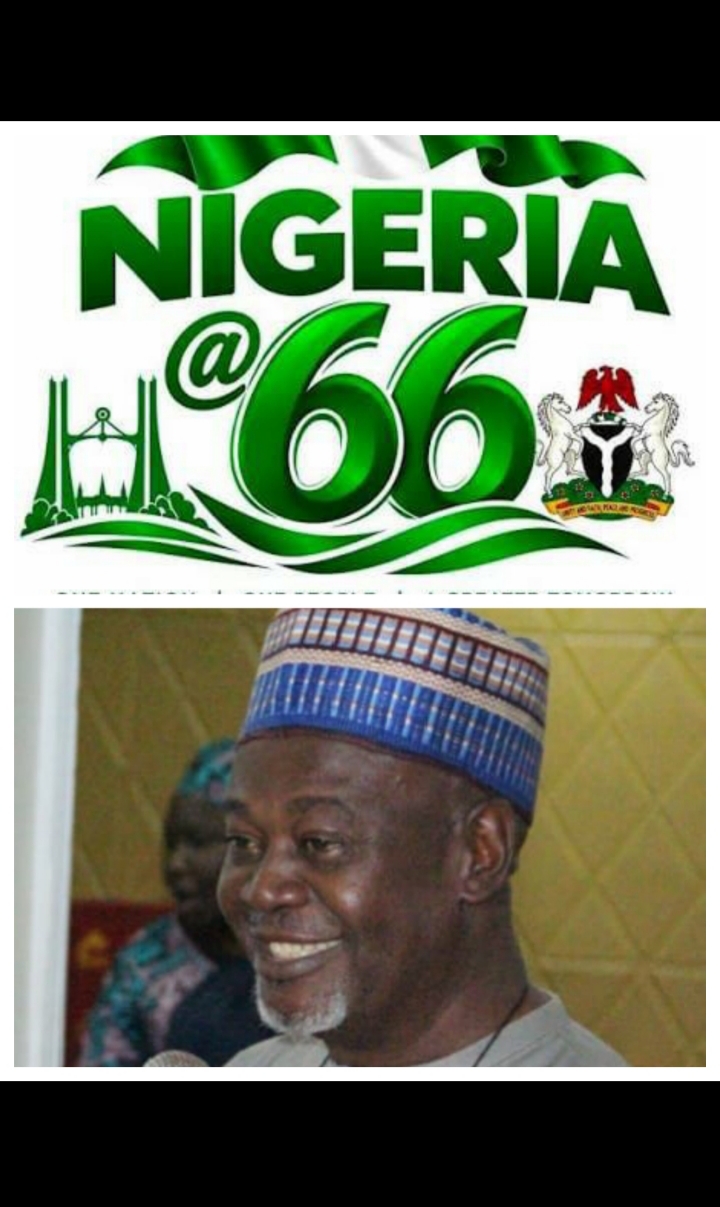
INDEPENDENCE:
ARE WE TRULY FREE? THE NIGERIA WE HAD, THE NIGERIA WE NEED
By Lai Gidado
As Nigeria celebrates another Independence Anniversary, I am reminded of my childhood and the meaning of independence once had for ordinary Nigerians.
I vividly remember celebrating Nigeria’s Independence Day in my primary school, AUD Primary School, Ajilosun, Ado-Ekiti, in the then Western Region. It was a special feast day that brought joy and excitement to the pupils.
Some rams and goats were slaughtered, bags of rice were cooked and served to us, accompanied by Krola soft drinks in special green-white-green disposable cups. We were also given Nigerian flags. It was a memorable and genuinely happy day for us as children.
Unfortunately, I cannot remember whether we had another Independence Anniversary celebration of that magnitude after my Primary Four until I completed my elementary education.
May Almighty Allah grant the soul of our then Headmaster, the late Mr H. A. Bello, and those of the other dedicated teachers of that era eternal rest.
Children love celebrations. They love to see their teachers happy, their schools decorated and their country celebrated. Those moments created a sense of belonging and patriotism that many of us carried into adulthood.
I must also not forget our principal at African Church Comprehensive High School, Ikere-Ekiti, the great Oyewole Jegede, a school administrator like no other. He always organised our School Fish and Iyan Festival to coincide with the Independence Anniversary celebration.
Those were the days when teachers were happy and proud of their profession. Civil servants were also proud to serve and contribute their quota to the development of Nigeria. There was a stronger sense of responsibility, patriotism and collective ownership of the country.
Are we really independent?
In 2015, on October 1, I sent a Happy Independence Anniversary message to a friend from the Niger Delta region. His response surprised me.
He simply asked: “Are we really independent?”
I replied, “Yes. But why are you asking?”
His response has remained with me ever since.
He said Nigeria might have gained independence from Britain, but that Nigerians were now living under another form of colonialism — the colonialism of political elites.
He asked me: Can you not see that we depend on a few political elites for almost everything we want to achieve?
According to him, you must “belong” before you can enjoy a good life. You must belong before you can secure a good-paying job. You must know someone before your qualifications can receive proper recognition.
He gave examples that were difficult to ignore: a graduate getting a job because he or she is the child of a politician, while another graduate with excellent academic qualifications struggles to secure even a primary school teaching appointment.
Is that the freedom our fathers fought for?
What kind of freedom exists in a country where citizens with good ideas and legitimate business plans cannot easily access affordable credit from banks, while those with political connections can reportedly secure enormous facilities?
What kind of freedom exists when an ordinary citizen with an excellent idea and the requisite qualifications finds it difficult to contest an elective position because of the enormous financial and political barriers surrounding elections?
I told my friend that, yes, Nigeria is politically independent. But independence should mean more than merely replacing colonial rulers with indigenous rulers.
Our independence should translate into economic freedom, social justice, equal opportunity, security and a government that genuinely serves the people.
Let us revisit our history
Perhaps what Nigeria needs is to look back at some of the principles and structures through which our founding fathers managed the country before independence and during the early post-independence years.
I strongly believe that the question of restructuring deserves urgent and serious national attention.
For me, a return to a stronger regional system of government is one option that Nigerians should continue to discuss openly.
The regions should enjoy substantial autonomy to develop according to their peculiar circumstances, while remaining part of a united Nigeria.
History provides important lessons.
In 1959, at a time when many European countries that Nigerians today look up to for assistance were still developing their own institutions, the Western Region had already established a television station and a radio service.
The Western Region also introduced free primary education, created Cocoa board, farm settlements where farmers rear cows, demonstrating that sub-national governments could pursue ambitious development programmes when given sufficient responsibility and resources.
The lesson is not necessarily that Nigeria must simply recreate the past. Rather, we should examine what worked, understand why it worked and determine how those principles can be adapted to today’s realities.
Resource control
Resource control should also form an important part of any serious restructuring conversation.
Each region should have greater responsibility for developing and managing the resources within its territory, while remitting an agreed percentage to the central government for national responsibilities.
The current arrangement, in which the Federal Government remains heavily dependent on petroleum revenues while significant solid mineral resources across the country remain inadequately harnessed and regulated, requires serious reconsideration.
If petroleum resources are considered a national asset, then the same principles of transparency, accountability and equitable management should apply to the country’s vast solid mineral resources.
What is good for the goose should also be good for the gander.
The cost of governance
Another issue Nigerians must confront is the cost of governance.
I have often argued that the present bicameral National Assembly is expensive for a developing country such as Nigeria.
The House of Representatives, in my view, could adequately perform the legislative responsibilities at the national level if the constitutional structure were redesigned accordingly.
At the state level, we already have Houses of Assembly, while local governments also have legislative structures.
The question Nigerians should continually ask is: How much does governance cost us, and how much of that cost is justified by the results we are getting?
A situation in which political representatives enjoy enormous privileges while many citizens struggle to meet basic needs deserves serious national reflection.
Who is serving whom: the people serving government, or government serving the people?
A new constitutional agenda
Nigeria urgently needs a new constitutional conversation.
The 1999 Constitution, as amended, has been the subject of decades of debate and criticism. Rather than endlessly patching a system that many Nigerians believe requires fundamental changes, the country should have an honest national conversation on the kind of political structure that will best serve its diverse people.
Such a conversation must be inclusive and must reflect the aspirations of Nigerians across regions, ethnic groups, religions, professions and generations.
The objective should not merely be constitutional change for its own sake, but the creation of a system that promotes accountability, equity, development, security and genuine democratic participation.
Restructuring and development commissions
In this regard, I acknowledge the Federal Government’s creation of development commissions for different regions, including the South East Development Commission and South West Development Commission, among others.
The establishment of such institutions can contribute to addressing regional development gaps if properly managed.
My only prayer is that those entrusted with these responsibilities will see themselves as servants of the people rather than “Oga Bosses”.
The success of these commissions will ultimately depend on transparency, accountability, competent leadership and the willingness to put public interest above personal interest.
Protecting our solid mineral communities
Nigeria must also take the issue of solid mineral resources seriously.
Many communities endowed with valuable natural resources continue to face insecurity and displacement. In parts of the North-Central and other regions, insecurity has disrupted communities and created an environment in which illegal mining and criminal exploitation can thrive.
Government must strengthen security in resource-rich communities and ensure that Nigerians, particularly the host communities, benefit from the resources beneath their soil.
Foreign investors who come into Nigeria to exploit our mineral resources must operate within Nigerian laws and regulations, pay the appropriate royalties and taxes, and contribute to the development of the communities where they operate.
The people should not be driven from their ancestral homes while others extract their natural resources for profit.
The killings and insecurity affecting communities in Plateau, Nasarawa, Kebbi, Zamfara, Niger and other parts of the country require sustained and decisive attention.
Our natural resources should become instruments of development, not reasons for displacement, violence and death.
Transportation: We need alternatives
Transportation is another area that requires urgent attention.
Air travel has become increasingly expensive and remains beyond the reach of many ordinary Nigerians.
For instance, travelling by air between Abuja and Akure or Ado-Ekiti can cost hundreds of thousands of naira, depending on the season and availability of flights, despite the relatively short flight time.
This situation makes efficient rail transportation even more important.
Nigeria needs an integrated and affordable railway network that connects major cities and regions, while also providing citizens with safer alternatives to road transportation.
A rail corridor connecting Ibadan, Akure and Abuja, with appropriate connections serving Ondo, Ekiti, Osun, Kogi and parts of Edo States, would significantly improve movement, commerce and economic integration across the region.
We should also revive and expand our inter-state road transportation system. Good roads, functional railways and affordable air travel should complement one another rather than one mode becoming the only realistic option for citizens.
The Nigeria we had
As I look back at the Nigeria of my childhood, I remember a country where people seemed to have greater confidence in tomorrow.
I remember teachers who took pride in their profession. I remember civil servants who regarded public service as a responsibility. I remember schools where Independence Day was not merely an event on the calendar but an occasion for children to learn about their country and develop a sense of belonging.
I remember the green-white-green flags, the excitement of children, the food, the music and the feeling that Nigeria belonged to all of us.
Perhaps that Nigeria was not perfect. Indeed, no country is.
But there were certain values that appeared stronger: discipline, patriotism, community spirit, respect for institutions and the belief that hard work could provide a pathway to a better life.
Today, many Nigerians are asking whether those values have been eroded.
What kind of independence do we want?
Independence should not simply mean that a country’s flag is raised by its citizens instead of a colonial power.
True independence should mean that a young graduate can compete fairly for employment without needing a godfather.
It should mean that an entrepreneur with a viable business idea can access affordable credit without political connections.
It should mean that a farmer can cultivate his land without fear of being displaced.
It should mean that a child from a poor family can aspire to become a doctor, engineer, teacher, lawyer, scientist, civil servant or political leader based on ability and hard work rather than family connections.
It should mean that citizens can travel safely from one part of the country to another.
It should mean that communities blessed with natural resources are not condemned to poverty while others profit from those resources.
It should mean that government officials remember that political office is a responsibility, not a personal entitlement.
Above all, independence should give every Nigerian a reasonable opportunity to live a dignified life.
The Nigeria we need
The Nigeria we need is not necessarily the Nigeria of the past.
Neither should we blindly copy the political arrangements of the First Republic.
What we need is to learn from our history and build a system that works for the realities of today’s Nigeria.
We need a Nigeria where federalism is meaningful, where states and regions have sufficient room to innovate and develop, where local communities have a voice in decisions affecting them and where the Federal Government concentrates on matters that genuinely require national coordination.
We need institutions that work irrespective of who occupies political office.
We need a justice system where the ordinary citizen can confidently seek justice.
We need security agencies that protect citizens and communities without discrimination.
We need an educational system that prepares our children not merely to seek employment but also to create opportunities.
We need a health system that does not force citizens to travel abroad or spend their life savings before receiving quality medical treatment.
We need agriculture that is treated as a serious economic sector rather than a political slogan.
We need to harness our enormous mineral resources responsibly and transparently.
We need technology, innovation and industrialization to become central to our national development strategy.
Most importantly, we need leaders who understand that the resources of Nigeria belong to the people.
The responsibility of citizens
But government alone cannot build the Nigeria we desire.
We cannot demand accountability from government while refusing to account for our own actions.
We cannot condemn corruption in public office while celebrating the same corruption when it benefits us personally.
We cannot demand good roads, electricity, security and schools while destroying public infrastructure or refusing to pay legitimate taxes and levies.
We cannot complain about politicians who buy votes while willingly selling our votes for temporary benefits.
Democracy requires responsible citizens as much as it requires responsible leaders.
The Nigeria of our dreams will be built not only by government, but also by teachers, farmers, traders, journalists, civil servants, entrepreneurs, professionals, religious leaders, traditional rulers, students, workers and millions of ordinary Nigerians who choose to do the right thing.
Let us recover the Nigerian spirit
Perhaps the greatest challenge before us is not merely constitutional or economic. It is the restoration of confidence.
We must restore the belief that Nigeria can work.
We must restore the belief that merit can triumph over mediocrity.
We must restore the belief that public service is service.
We must restore the belief that a person’s future should not depend on who he knows.
We must restore the belief that Nigeria belongs to all Nigerians.
The green-white-green flag should therefore mean more than a national symbol.
The green should remind us of the abundance of our land and the possibilities before us.
The white should remind us of peace, unity, justice and the responsibility to live together despite our differences.
And the flag itself should remind us that this country belongs to all of us.
Independence Day: A time for reflection
As i celebrate another Independence Anniversary, I remember the little boy at AUD Primary School, Ajilosun, Ado-Ekiti, holding the Nigerian flag and enjoying rice and Krola soft drink with his classmates.
I remember the excitement.
I remember the school celebrations.
I remember teachers who made us feel that Nigeria was something worth celebrating.
More than five decades later, the question my friend asked me in 2015 still echoes in my mind:
“Are we really independent?”
My answer today remains the same, but with a deeper understanding.
Yes, Nigeria is politically independent.
But our journey towards economic freedom, social justice, equal opportunity, security, responsible leadership and genuine democratic participation is still ongoing.
Independence is not a destination reached once and forever. Every generation has a responsibility to redefine what freedom means and to strengthen the institutions that protect it.
The generation that fought for political independence gave us a country.
It is our responsibility to build a nation worthy of the sacrifices of those who came before us.
Let us therefore celebrate Nigeria, but let us also question Nigeria.
Let us remember our past, but let us not live in it.
Let us acknowledge our failures without losing hope.
Let us challenge our leaders without abandoning our responsibilities as citizens.
And let us continue to work, pray and dream for a Nigeria where every child, regardless of birthplace, family background, religion, ethnicity or social status, has a fair opportunity to succeed.
That, to me, is the Nigeria we need.
That is the Nigeria our children deserve.
And perhaps, when another generation gathers to celebrate Independence Day, they too will look back and say:
Nigeria became the country we always believed it could be.
Happy Independence Anniversary, Nigeria.
May God bless our country.
Lai Gidado, the publisher of Ebony Herald International Magazine and Abuja Herald Newspaper , writes from Kubwa Abuja FCT Nigeria