AAUA DON NNAOMA IWU WARNS AGAINST NEGATIVE ETHNICITY EXPLOITATION TOWARDS ACHIEVING SOCIETAL DEVELOPMENT
Professor Nnaoma Iwu has advocated the adoption of a technology driven football theory approach that prioritises skills and talent over ethnicity, educational qualifications, and religion.
He argues this is essential for Nigeria to compete effectively with other nations in the 21st century era of technological innovation.
He warned that the country will continue to suffer technological setbacks caused by ethnic diversity unless it adopts a strategy that identifies, trains, and supports individuals with specialised skills, enabling them to take their rightful place in the workforce.
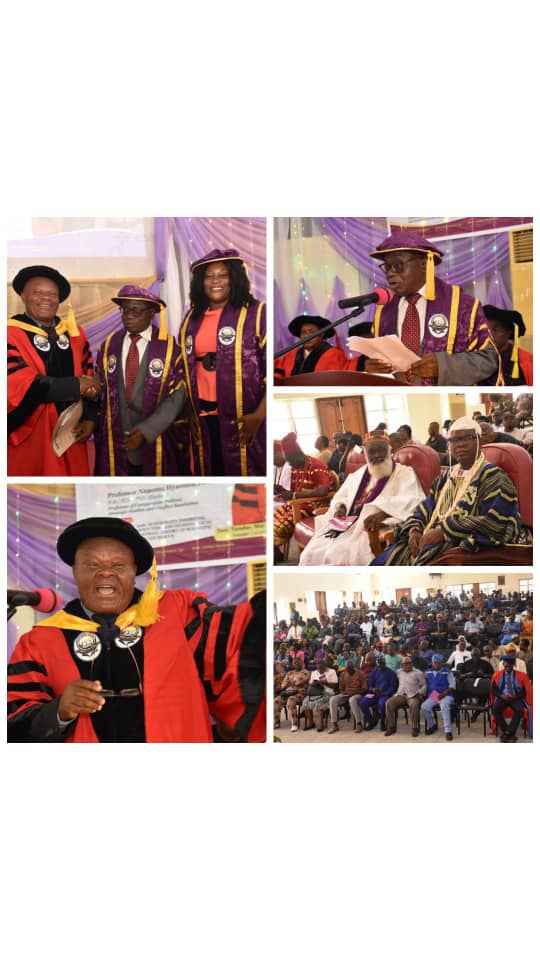
Iwu, a Professor of Comparative Politics, Strategic Studies, and Conflict Resolution, proposed this theory on Tuesday, 5 May 2026, while delivering the 61st inaugural lecture of Adekunle Ajasin University, Akungba Akoko.
The lecture was titled, “Killing the ‘Gods’ of Ethnicity Inhibiting Nigeria’s Journey towards Technological Innovation: Football Theory of Scientific Development to the Rescue.”
According to him, studies have shown football to be a source of unity, shared interest, and support among diverse groups in Nigeria.
He noted that its player selection process emphasises skills above socio-demographic characteristics, highlighting the potential effectiveness of applying these principles to innovation and technology.
The political scientist further explained that ethnicity itself is not Nigeria’s main problem; rather, the issue lies in how it is used.
He noted that the negative exploitation of ethnicity can trigger or worsen conflicts in diverse societies and may prevent qualified, talented individuals from securing the positions they deserve.
This, he said, underscores the need to move away from prevailing narratives about ethnicity and focus more on developing science and technology to enable Nigeria to compete with other nations.
While highlighting tertiary institutions as major players in the adoption and effective implementation of the football theory, he described them as the national, state, or local teams that provide platforms where innovative ideas are assembled to drive scientific and technological development.
He further identified academic staff as the coaches, while students, fellow lecturers, and non-students, including members of the wider community, serve as players.
Prof. Iwu explained that the role of the coaches, professors and other lecturers, is to identify skills among students, colleagues, and community members, and to train them to develop their potential in science, technology, and innovation.
He noted that this is essential because many skills can be scientifically harnessed for economic development, particularly through partnerships with individuals and organisations across Africa and beyond.
Such collaboration could facilitate the production of components used in manufacturing finished goods, thereby ensuring efficiency and improved outcomes.
He added that imaginative thinking, often displayed by lecturers, students, and members of the public, can contribute significantly to innovations.
He cited examples such as individuals skilled in the use of medicinal herbs, traditional medical practitioners, herbal medicine preparation, goldsmiths, bone-setters, and others found in various Nigerian communities.
Emphasising the role of the academic community, the don endorsed the integration of football theory into the curriculum of all second year students in educational institutions as a general course.
He suggested that physical products should serve as criteria for awarding certificates in science based disciplines and technical education at all levels.
He added that proven skills and talents should form the basis of employment into research institutions.
Prof. Iwu also recommended that English language and Mathematics should not be made compulsory for individuals with innovative skills and talents seeking admission into any educational institution in the country.
He noted that this policy would provide opportunities for aspirants with specialised technical skills to gain admission into higher institutions, where they could acquire further knowledge and training.
In his remarks, the Vice Chancellor and Chairman of the occasion, Prof. Olugbenga Ige, represented by the Deputy Vice Chancellor (Administration), Prof. Adebisi Daramola, noted that the institution’s inaugural lectures serve not merely as an academic tradition but as a forum for bold ideas, public engagement, and social commentary.
He commended Prof. Iwu for his exemplary service and sustained scholarly impact on the university and the wider community.